
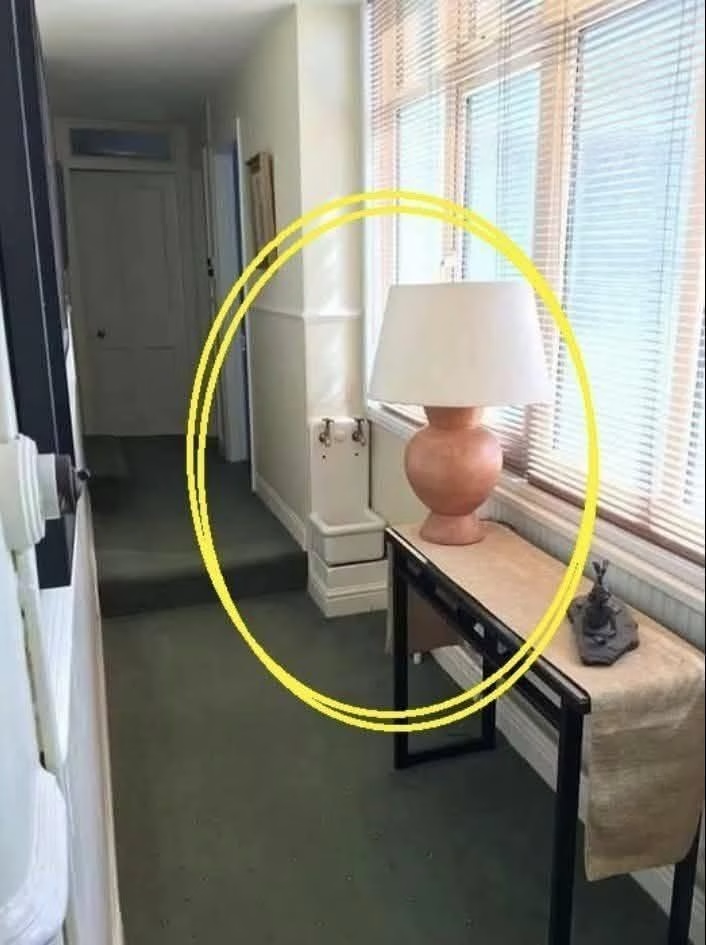

The Hallway Sink Mystery: When Practical Design Looked Absurd
Introduction
You’re wandering through a historic home, admiring the craftsmanship, when suddenly—wham.
A sink. In the hallway. Not in a bathroom. Not in the kitchen. Just standing there like it
owns the place.
You pause. You blink. You wonder who, exactly, thought this was a good idea.
A viral Reddit post recently sent the internet into a spiral over one such “hallway sink,”
with theories ranging from foot-washing station to plumbing mishap.
But the truth is far more practical—and surprisingly clever.
Ingredients (What You’ll Find)
- One small porcelain sink
- Separate hot and cold taps
- Minimal counter space (if any)
- Strategic hallway placement
- A century-old home with limited plumbing
Ingredients Highlights
The Sink: Compact, utilitarian, and designed for quick use—not comfort.
The Location: A high-traffic hallway where guests naturally passed through.
The Era: Early 1900s, when indoor plumbing was a luxury, not a guarantee.
Formation (How This Design Came to Be)
Hallway sinks emerged during a transitional period in home design.
Bathrooms were rare, often located upstairs, while entertaining guests
happened on the main floor.
The solution? Install a small sink in a shared space where guests could
wash their hands or faces without invading private areas of the home.
Methods (How It Was Used)
- Quick hand washing before meals
- Removing street dust, soot, or coal residue
- Maintaining hygiene without bathroom access
- Preventing guests from wandering upstairs
Instructions (The Hallway Sink at Work)
- Guest arrives from dusty streets or horse-drawn travel
- Guest pauses in hallway
- Hands are rinsed quickly and discreetly
- Guest enters dining room clean and presentable
- Dinner proceeds without hygiene-related chaos
History of the Hallway Sink
In the early 1900s, most homes had only one bathroom—if any.
Sending dinner guests upstairs to wash was impractical and socially awkward.
Kitchens were busy, working spaces and not considered appropriate for guests.
Hallways, however, were communal, transitional zones—perfect for quick hygiene stops.
As germ theory gained acceptance, cleanliness became a social expectation.
The hallway sink quietly answered that need.
Benefits of This Forgotten Design
- Improved hygiene before meals
- Reduced bathroom congestion during gatherings
- Preserved privacy of bedrooms and upstairs spaces
- Efficient use of limited plumbing infrastructure
- Elegant problem-solving without excess say
Why It Looks Strange Today
Modern homes feature multiple bathrooms, powder rooms, and en-suites.
The hallway sink has lost its purpose, leaving behind a fixture that
feels oddly out of place to contemporary eyes.
What once screamed practicality now whispers confusion.
Lovers of This Architectural Quirk
- Old-house enthusiasts
- Architectural historians
- Design minimalists
- Fans of Victorian ingenuity
- People who appreciate clever solutions
Conclusion
The hallway sink was never meant to be glamorous.
It was a quiet servant of hygiene, hospitality, and social order.
A solution born from necessity, not aesthetics.
Final Conclusion for Lovers of Old Homes
What looks bizarre today was once brilliant.
The hallway sink wasn’t a design flaw—it was a Victorian-era life hack.
And in a world that still struggles with practical problem-solving,
there’s something refreshing about a sink that simply did its job,
right there in the hallway.